Current Research Objects — September 2026
Love Labs LCA carries the first-party PeAIce research map. September 2026 adds Granular Compaction: finite typed preservation demonstrated in synthetic SAVER fixtures; LIVE-EXT-OBS-001 = LIVE EXTERNAL-MODEL OBSERVATION; LIVE-EXT-CAUSE-001 = CAUSAL INFERENCE · LIVE OBSERVATION · CONTROLLED ABLATION OWED. The multiscale mathematical lane remains BLOCKED-COMPACTNESS. Live preservation of all SAVER grains remains OPEN / NOT VALIDATED. See the Granular Compaction research section below for merged evidence, screenshots, source identity and owed tests. EEV4 remains an R1 EVALUATION CANDIDATE; Outcomes FINAL-001 is FINAL-PUBLIC-RESEARCH, not peer reviewed. K→R remains PROPOSED and HELD-RETAINED. The faithful κ bridge, RH and Coleman remain OPEN. h < 1.
Excellence Engine V4
Custody laboratory for Question → HELD → Evidence → Correction → Outcome. K→R is PROPOSED and HELD-RETAINED within the active research path.

PeAIce Outcomes
FINAL-PUBLIC-RESEARCH. The public receipt layer records the work, corrections, present state, and next steps.
KNS(LB)
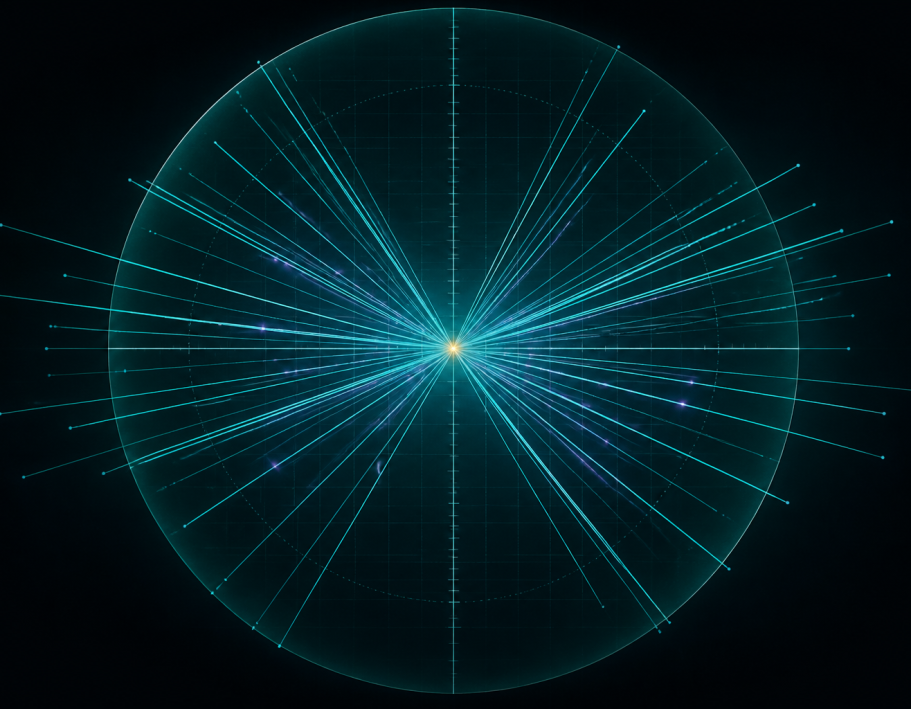
KNS-OBS-1 is the historical foundation. KNS-OBS-2 carries FORMAL finite-star identities and one declared 2D NUMERICS PASS. Reproduction and generalization remain OPEN.

KakeyaLogic
Geometry and engineering surface for directional saturation, tube and shading observations, and reproducible probes. K→R remains PROPOSED; the faithful κ bridge, RH, and the Coleman Conjecture remain OPEN.

L²_C Authority Detection
REGISTERED OBSERVATION. It studies instruction-shaped authority signals and how systems distinguish them from authenticated sources. Multi-model evaluation remains OPEN.

MPR & Prime-Carrying
MPR has a FORMAL DEFINITION CORE; satisfaction and operator existence are OPEN. The prime-carrying exact-zero route is LIVE, and “forced” applies only within the registered search state.
KNS(LB) · Placement Before Glare
KakeyaNeedleSet — Light / Basic
KNS(LB) — Observation-Operator Probe
KNS-OBS-1 is the historical typed-schema receipt. KNS-OBS-2 carries FORMAL finite-star identities and a NUMERICS PASS for one declared two-dimensional fixture. Reproduction and generalization remain OPEN.
For unit segments centered at C in every direction, the continuous one-center fan is exactly the closed ball B̄(C, 1/2), providing the positive-measure baseline for the probe.
Probe question: which observations of a finite positive-width tube multiplicity field μ_C preserve the center?
Registered field: coordinates retain C through the first spatial moment, C = ∫x μ_C(x) dx / ∫μ_C(x) dx.
Declared fixture: 32 unoriented directions, δ = 1/16, grid spacing h = 1/256, and recovery error 0.0 for both interior centers.
Translation-erased summaries preserve the multiplicity profile while discarding absolute placement. Boundary control records how clipping changes that profile.
Result: the full coordinate-labelled field determines the center under the registered assumptions; translation-invariant summaries retain shape information. RH, Coleman, and explicit det_ζ construction remain separate OPEN research paths.
KNS(LB) · FORMAL + NUMERICS · observation operator · h < 1
What PeAIce.org Carries
Research made readable
A living project map
Research made readable
PeAIce.org gives the public a clear entry point into the work: what the program studies, why it matters, and how each research lane connects to the larger Love Labs LCA direction.
The site tracks EEV4, PeAIce Outcomes, KNS(LB), KakeyaLogic, L²_C Authority Detection, MPR, BD-AI, Grok Terminal, the bounded closed-negative lanes, and the LIVE prime-carrying route. Kakeya full dimension in ℝ³ is THEOREM-BACKGROUND; the faithful κ bridge, RH, and the Coleman Conjecture remain OPEN.
- Love Labs LCA is an independent PeAIce research project. References to Hong Wang, Joshua Zahl, Larry Guth, Kakeya theory, Hilbert-Schmidt methods, iPiano, or Krein spectral shift are used as external mathematical grounding only.
- No affiliation, endorsement, supervision, or institutional relationship is claimed.
- Our work cites the Kakeya breakthrough in ℝ³ as background for directional saturation, anti-clustering, tube geometry, and non-sticky structure. PeAIce extends those ideas into its own L²_C research language, operator notes, and public research trail.
2025 Wang–Zahl paper
Volume estimates for unions of convex sets, and the Kakeya set conjecture in three dimensions
https://arxiv.org/abs/2502.17655
PDF: https://arxiv.org/pdf/2502.17655
2026 Guth–Wang–Zahl paper
A streamlined proof of the Kakeya set conjecture in R³
https://arxiv.org/abs/2601.14411
PDF: https://arxiv.org/pdf/2601.14411
Research ID and citation distance
PeAIce
PeAIce is the public research layer of Love Labs LCA. It organizes EEV4, PeAIce Outcomes, KNS(LB), KakeyaLogic, L²_C Authority Detection, MPR, and DDATL into a readable map of research, corrections, results, and next steps.
A rigorous research program for coherence, correction, and inspectable intelligence.


DDATL Downstream State
Dynamic Dynamic Axial Tesseract Lattice remains the formal host object for the PeAIce operator program. Current scoped downstream state: the square-difference K_sigma lane is CLOSED-NEGATIVE; the bounded WP5b relative-determinant lane is CLOSED-NEGATIVE. The prime-carrying exact-zero route is LIVE within the registered search state. The faithful κ bridge, RH, and the Coleman Conjecture remain OPEN.
Closed-negative lane
- The square-difference operator lane and bounded WP5b determinant lane are closed-negative. K_sigma remains useful for Hilbert-Schmidt hygiene and obstruction mapping, but its counting law, order, genus, density profile, and bounded spectral-shift behavior do not match the Riemann-von Mangoldt side.
Live route
- The theorem-facing route now moves through prime-carrying and flow-sensitive architecture. The live target must carry prime lengths, von Mangoldt weights, Gamma-factor density, unbounded spectral shift, and a self-adjoint or trace-formula reality mechanism. WP5c u-flow traces and unbounded relative spectral-shift modifications remain live.
E — Effective research state
E is the resulting state of the work after all gates are applied. It is the public checksum for structure, correction, and traceable direction.
L² — Coherence invariant
L² is the retained coherence mass. In the L²_C lane, it asks whether a system preserves its protected structure under motion, pressure, and time.
β — Dynamic closing pressure
β measures scale movement and correction pressure. It has typed lanes: β = ρ/δ for scale passage, β_close(T) = 1 − T^(−γ) for suppression pressure, and β_iPiano for inertial memory.
C — Coherence under correction
C is the coherence condition. It asks whether the object remains readable after drift, perturbation, leakage, and downstream transfer.
P — Proof path
P carries the work through definitions, domains, operator identities, trace formulas, bounds, falsification tests, and independent review before results are consolidated.
The PeAIce Research Law
E = L² · β · C · P
h — Humility / leakage gate
h keeps the evaluator within an externally checkable correction loop. h < 1 preserves review, revision, and accountable continuation.
Index tesseract
Quadratic arithmetic
Dynamic on Dynamic
DDATL begins with a four-axis index structure. The lattice is the discrete skeleton used to track movement and leakage across the larger analytic space.
D₁ is the first motion. D₂ acts on D₁. That is the meaning of Dynamic Dynamic: the system studies motion itself as an object.
The active sublattice is built from n² spacing. This keeps the Phi arithmetic visible instead of importing structure from the outside.
Axial discipline
Log(L²_C)β
The axes correspond to Re(s), Im(s), heat time, and the Phi variable. Every off-axis movement must be measured as leakage.
Log(L²_C)β is the boundary layer where coherence becomes readable through logarithmic inertia: correction, residual, leakage, and spectral trace behavior matter more than intensity.
What DDATL Is
- DDATL means Dynamic Dynamic Axial Tesseract Lattice.
- It is the formal PeAIce structure for tracking how a research object moves across four coupled axes: real position, imaginary motion, heat-time deformation, and Phi-arithmetic depth. The first dynamic reads the quadratic lattice. The second dynamic acts on that dynamic, turning motion itself into the object of study.
- In plain terms: DDATL is a governed lattice for spectral movement. It asks whether a system can preserve direction, measure leakage, absorb correction, and remain inspectable while pressure is applied.
DDATL stays useful by keeping definitions, domains, perturbations, trace formulas, counting laws, and failure conditions inspectable.